
Here are your assignments for this week.
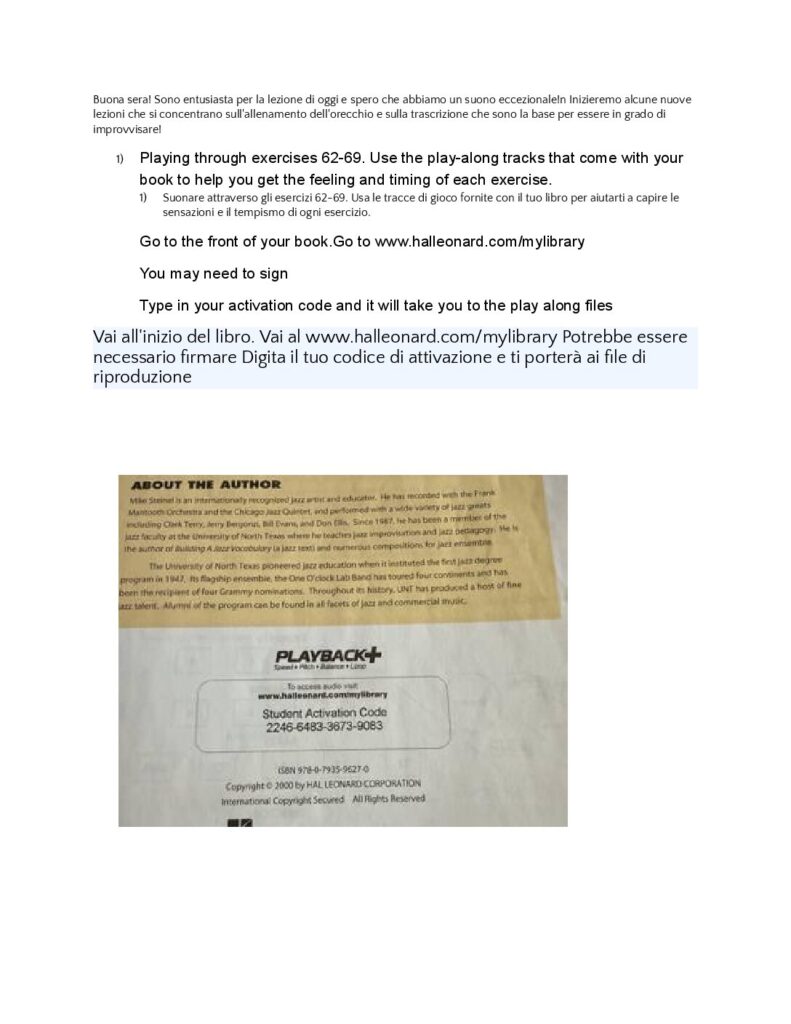
- Be able to play along with the tracks from your book. When you play an exercise use the play-along! Send a video of you using the play-alongs this week. Try and get all the exercises 62-69 ready to play by next Tuesday.
- Transpose London Bridge from Bb concert, (it means the way it sounds) to the key of C by raising all the notes by 1 whole step.
- Transcribing: Try to figure out the next two notes Miles play
Lesson 1: Learn how to use the play-along tracks to hear how the exercises sound. It will help you learn faster and know how the exercise should sound
Lesson 2) Starting to transpose
Transposing means to take a piece of music in one key and change it to another key
A note: A transposing instrument is a musical instrument for which music notation is not written at concert pitch (concert pitch is the pitch on a non-transposing instrument such as the piano). For example, playing a written middle C on a transposing instrument produces a pitch other than middle C; that sounding pitch identifies the interval of transposition when describing the instrument. Playing a written C on clarinet or soprano saxophone produces a concert B♭ (i.e. B♭ at concert pitch), so these are referred to as B♭ instruments. For Alto if they play a written C it produces an Eb
.A key tells us the scale that the music is in. We are playing all of our songs in the key of Bb.
The key of Bb is based on the following scale
Bb C D Eb F G A Bb- these are the notes the piano, guitar, bass and flute play
C D E F G A B C- are the notes the soprano sax play
G A B C D E F# G – are the notes the alto saxophone play
For our first lesson in transposing we are going to play London Bridge in the key of C
Look at your book for exercise 27
To play London Bridge in the key of C ( concert) you raise each note by 1 whole step
If the note is F you change it to a G. Go through and raise each note by a whole step.
If you are playing Alto sax you would change your first note to a D to an E
For soprano you would change your first note from C to D
Lesson 3)
June 17th Lesson on Transcribing ( in english) Italian translation below
The most important skill in learning to improvise is to transcribe the music of great jazz musicians. It can feel very hard to do at first. I know I have felt that way but you can do it.
The most important thing is to figure out what note is being played only using your ears.
For this first time we are going to use the first chorus (12 bars) of Miles Davis’s solo on Freddie the Freeloader. It is a Bb blues just like we have been working on.
We are going to go very slowly, so no pressure. It is more important to try and find the note on your instrument and not look it up on the internet.
Here is the first chorus. click on the link below to hear the first chorus.
https://youtube.com/clip/UgkxkP90vuzL-YwhJLGRc5pOLgb6qs66DCqb?si=9xXu1wqhmoFUNxci
The first 3 notes are a concert Bb. C for soprano and G for alto.
Here’s what I did. I would play the Bb and noticed the note was below the Bb so I started playing notes that were lower until I it sounded like the right note. Then I would go back and forth playing and listening until I felt I knew what the note was. It is more important to do this lots of times and not worry at first if its “correct”. The important part is starting to use your hearing!.
Here is the C part, I am going to give you the first note, which is a G

Here is the Bb part. Notice it is a whole step above the C part

And here is the Eb part

So for this week try and figure out the next note!
Here is the Italian translation
Lezione del 17 giugno sulla trascrizione
L’abilità più importante nell’improvvisazione è trascrivere la musica di grandi musicisti jazz. All’inizio può sembrare molto difficile. So di averla provata anch’io, ma ce la puoi fare.
La cosa più importante è capire quale nota viene suonata usando solo le orecchie.
Per la prima volta useremo il primo ritornello (12 battute) dell’assolo di Miles Davis su Freddie the Freeloader. È un blues in Sib, proprio come quello su cui abbiamo lavorato finora.
Procederemo molto lentamente, quindi niente pressione. È più importante cercare di trovare la nota sul proprio strumento piuttosto che cercarla su internet.
Ecco il primo ritornello
https://youtube.com/clip/UgkxkP90vuzL-YwhJLGRc5pOLgb6qs66DCqb?si=9xXu1wqhmoFUNxci
Le prime 3 note sono un Si♭ da concerto. Un Do per soprano e un Sol per contralto.
Ecco cosa ho fatto. Ho suonato il Si♭ e mi sono accorto che la nota era sotto il Si♭, quindi ho iniziato a suonare note più basse finché non ho sentito che suonava la nota giusta. Poi ho continuato a suonare e ascoltare finché non ho capito qual era la nota giusta. È più importante ripetere questo esercizio più volte e non preoccuparsi all’inizio se è “corretta”. La parte importante è iniziare a usare l’udito!
Ecco la parte del Do, vi darò la prima nota, che è un Sol.
Ecco la parte del Si♭. Nota che è un tono sopra la parte in Do.
Ed ecco la parte in Mib.
Quindi, per questa settimana, prova a indovinare la nota successiva!